
Finding a Danville Property Owner
Finding a Danville owner works best as a chain rather than a single name search. Start with the address in Danville's GIS viewer. Note the parcel account ID and the legal description. The owner1 and owner2 fields give the assessment's owner of record. The latest land-record deed confirms the transfer. When an LLC or other registered business appears, the State Corporation Commission's entity records identify the company behind the name. Keep every step tied to the same parcel. A matching name alone is not proof.
- Locate the situs address in the Danville Parcel Viewer.
- Write down the parcel account, owner fields, and legal description.
- Search the latest deed in Virginia SRA and match the parties and land description.
- For an entity name, check the Virginia SCC filing record, then return to the deed to confirm the parcel link.
Danville Property Owner Sources
Each Danville system offers a different ownership clue. The assessment office keeps owner and mailing details. The parcel schema lists owner1 and owner2. The land records held by SRA contain the recorded instrument, while the SCC identifies the business entity behind a name. A City tax bill answers billing questions, but the name that receives a bill is not always the person who occupies the land.
| Source | Owner Info It Gives | Access |
|---|---|---|
| Real Estate Assessment | Owner and mailing information maintained for the City roll | City eServices / office at 427 Patton Street |
| GIS parcel layer | owner1, owner2, account, site address, legal description | Danville Parcel Viewer and ArcGIS layer |
| Circuit Court Clerk / SRA | Grantor, grantee, instrument, legal description, recording reference | Remote access or Public Records Area |
| Virginia SCC CIS | Entity status, agent, principal office, filing history | Public business filing portal |
GIS owner fields reflect the tax roll, not occupancy. A mailing address routes notices, while the situs address locates the parcel. Records can also lag a closing by weeks. Danville guarantees no owner-roll refresh interval, so treat the name as a snapshot of the billing record rather than live title.
Limits of a Danville Owner Search
A name in the parcel layer is an owner field, not a resident. The mailing address may sit in another state. A company or a trust may be the grantee. An assessment card is not a title opinion either. Before a title professional can judge the chain, the deed search needs the legal description plus any related releases or liens.
Lawful use. Use Danville owner records for property research, purchase diligence, estate work, or civic purposes. Do not use names or addresses to stalk, threaten, or harass anyone; Virginia law separately addresses stalking and repeated unwanted conduct.
Danville Owner and Address Clues
Danville’s parcel layer calls the ownership fields owner1 and owner2. Its site_address field is the parcel location; the long legal field can help distinguish two nearby tracts with similar street names. The assessment division maintains mailing addresses, though a mailing-address field was not exposed in the captured REST schema. If the live card does not show it, ask Assessment instead of inferring it from the situs address.
For a tax question, Central Collections asks callers for parcel ID, address, bill, or owner deed name as of July 1. That tax-year anchor can explain why a recently closed property still appears under the earlier name for billing. Compare the deed date and recording date before reading the roll as the newest ownership event.
Confirm a Danville Owner by Deed
The parcel layer gives you a likely owner. Search SRA under the names shown. Confirm the latest deed before trusting the name. Read the grantor, grantee, recording date, deed reference, and legal description. The land-record index runs by name and document. A GIS account number may not work online. If the result is unclear, carry the name and tract description to the Clerk.
Danville reports land records from 1841 to the present. Back-scanning of deed books and indexes is complete through 1841. Remote images may still require the Clerk's authorization and subscriber terms. The index itself may remain open to view. The Circuit Court Clerk land-record page sets out counter and copy details. The same Clerk page is the local route for recorded deed access.
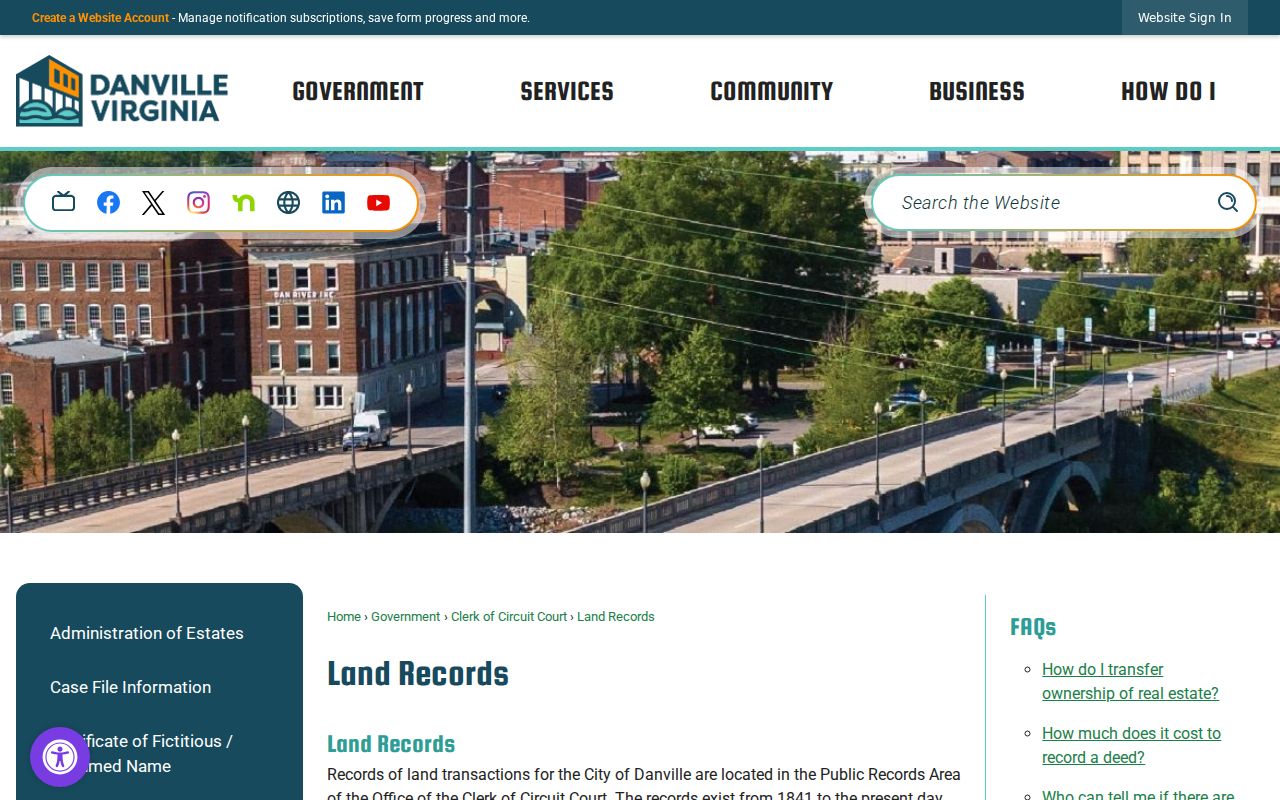
The latest recorded deed helps confirm a name tied to the mapped legal description.
Danville LLC and Business Owners
Company-held parcels are common in Danville. Run the entity's exact name through the Virginia SCC Clerk's Information System. Note the status, the registered agent, and the filing history. Those filings show which organization a name belongs to. But they do not prove it owns the parcel.
Treat the GIS owner name as a lead. Confirm the entity in the recorded deed. Then match the legal description to the parcel account. The SCC record describes the business. The Danville land record ties a business to a land transfer. The SCC Clerk's Information System provides the public entity lookup. The same state filing portal shows business records rather than a City parcel card.
Return to the recorded deed to verify the entity-to-property connection.
Danville Estate and Trust Names
Some Danville parcels vest in a trustee, executor, or estate representative. Search the name exactly as written. The deed and probate paperwork control the spelling. When a relative's name drops from the chain, the Circuit Court Clerk's wills and probate records may explain the transfer. The land-record instrument still fixes the recorded conveyance.
Virginia Memory's scanned Danville Chancery Causes, 1842 through 1913, add context when a partition, heirship, or boundary dispute drove a property transfer. The case files may name people and describe land. They do not replace the deed that followed. Keep the people search tied to the right tract with the parcel's legal description. The Chancery Records Index is an archive route for those older equity cases.
Danville Owner Lookup Privacy
Virginia runs an Address Confidentiality Program for survivors of domestic violence, stalking, child abduction, sexual violence, or human trafficking. Survivors of these crimes qualify. Those enrolled get a substitute address and mail forwarding. Program files are exempt from FOIA except for limited legal or law-enforcement purposes. Eligibility follows statutory rules. So the protections are strong by design. A public property search must not be used to work around them.
A missing owner name is not automatically a database error, either. Resist the urge to infer where someone lives from other records. Ask the custodian about the official public record instead. Use what you find only for lawful property or civic research.
Danville Owner Record Requests
For a current owner or mailing question, contact Real Estate Assessment at 434-799-5120 or visit Room 301 at 427 Patton Street. For a recorded deed, contact the Circuit Court Clerk at 434-799-5168 or use SRA. If a City permit or assessment document is not online, submit a focused Virginia FOIA request naming the parcel account, street address, record, and date range.
FOIA gives a public body five working days to respond under Virginia Code §2.2-3704. The office may provide records, identify an exemption, release a redacted copy, or explain that it cannot find or does not hold the record. It need not create a new report from existing information.
Reconcile Danville’s Tax Owner and Deed Grantee
In the parcel schema, the owner1 and owner2 fields are the verified tax-roll names. The REST layer exposes no mailing-address field, even though Assessment keeps mailing information on file. The City publishes no guaranteed update interval after a deed is recorded. So a mapped name needs a date. It takes a source, too, before it can settle any question about the latest conveyance.
Carry the same parcel account and legal description into your land-record search. Where the index allows, search the owner name as both grantor and grantee. Then compare the instrument's parties, capacity, record date, and land description. If a trust, estate, or LLC shows up, keep its legal name intact. Confirm the deed vests the property in that entity.
For an LLC, the Virginia SCC Clerk's Information System shows the business's status and registered agent. It also lists the principal office and filing history. Those state records help identify the organization. Still, an agent or manager is not automatically the parcel owner. The recorded deed still governs. Matched against the legal description, it ties the entity to the land.
When Assessment and the most recent deed disagree, ask a simple question. What effective date does each one represent? Danville anchors its assessment and tax year to July 1. The City has set no universal online refresh schedule. A mismatch often reflects different record dates rather than a flawed search result.