
Danville Property Tax Record Fields
Two City offices split the tax-record work in Danville. Real Estate Assessment lists and appraises real property. It also maintains ownership, mailing details, and parcel maps. Central Collections issues the bills, takes payments, and manages delinquent accounts. The parcel service links to related assessment and transfer tables. But no online value-detail screen or full tax-bill field list is available.
| Field | What It Shows | Where |
|---|---|---|
| Assessed value | Value used in the real-estate tax calculation | Real Estate Assessment |
| Owner and mailing record | Assessment roll name and bill-address maintenance | Assessment office and parcel layer |
| Tax bill | Installment amount, due date, and payment route | City real-estate tax services |
| Delinquent list | Monthly balance snapshot with listed penalties and other charges | Central Collections |
| Relief or abatement | Program application and parcel eligibility review | Finance / Real Estate Assessment |
A tax figure answers one question. It shows what the City bills under its current rules. That is not what a parcel might sell for. The GIS layer's last-sale fields offer separate clues. For an instrument's stated consideration, the recorded deed remains the source. Use the right office for the question. Confirm the current year's forms before applying for any relief.
Danville Tax Bill Lookup
Danville tax staff asks callers to have a parcel ID, property address, tax bill, or owner deed name as of July 1. That date anchors the City’s tax year, which runs July 1 through June 30. If a deed was recorded after the roll date, the new owner may not be the name used for that tax year. Use the tax account for payment status and the recorded deed to confirm a transfer.
- Find the parcel account in the City’s Real Estate Locator or have the parcel ID and address ready.
- Ask Central Collections at 434-799-5125 about the bill, payment, or delinquent balance.
- Ask Real Estate Assessment at 434-799-5120 about assessed value, ownership, mailing information, or relief.
- Compare the owner name with the most recent deed if a closing happened near the July 1 date.
- Assessed value
- The City value used to calculate real-estate tax.
- Tax year
- The City cycle that begins July 1 and ends June 30.
- Delinquent account
- A tax account with an unpaid balance; added collection charges may apply.
- Abatement
- A program that may reduce taxes on qualifying rehabilitation work.
Danville Assessment Appeal Route
Danville lays out three grounds for an assessment appeal. The fair-market-value opinion may be wrong. The assessment may not be uniform with comparable property, or a material error may have been made. The process starts with a review by the Division of Real Estate Assessment. It can include a field inspection. Board of Equalization hearings happen only in reassessment years. The City publishes no current appeal form or calendar online, so request those directly. Gather parcel-specific support before contacting the City. Bring the assessment notice or the value at issue, the parcel ID, and recent comparable property information. Also include any records showing a factual error. Keep assessed value distinct from the price you hope to get at sale. The City's page outlines the appeal process. Confirm the current reassessment schedule and filing instructions with the office itself.
Reassessment-year timing matters. The Board of Equalization hears appeals only in reassessment years. Danville has not published the current form and deadline in the research source set, so confirm the calendar with Real Estate Assessment before filing.
Danville’s $0.83 Tax Calculation
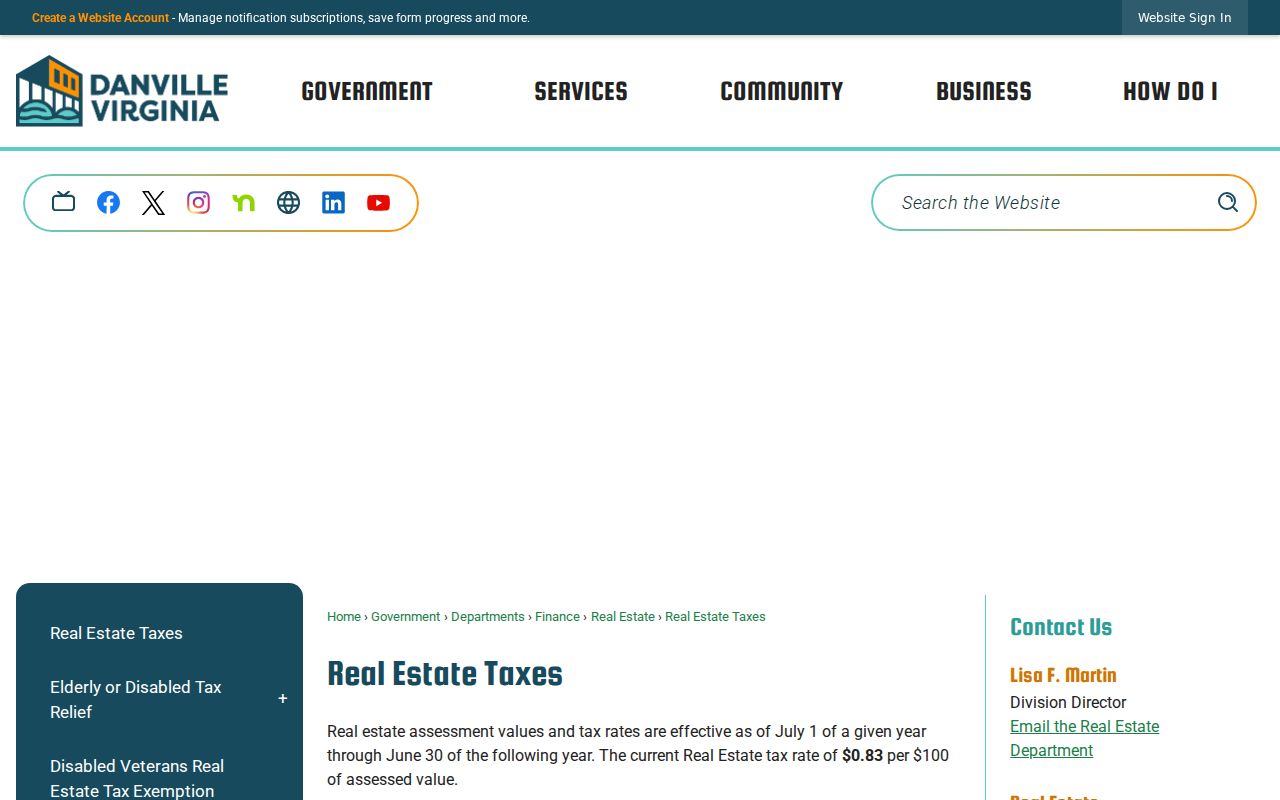
The City’s published real-estate rate is $0.83 per $100 of assessed value. In the City’s example, a $100,000 assessment produces $830 for the year, split into two $415 installments. This is a rate calculation, not a prediction of a parcel’s value or a quote for every account. Exemptions and program credits may change what is due.
The first half is mailed by November 5 and due December 5. The second half is mailed by May 5 and due June 5. Danville says that failure to receive a bill does not excuse payment and that no extensions or payment plans are available for real-estate taxes. Check the current City page for the schedule that applies to the tax year.
The Real Estate Taxes page publishes the rate, effective-date rule, and installment dates.
The City tax page gives the rate and bill schedule.
Use the parcel ID when asking staff to check a specific bill.
Danville Payments and Delinquency
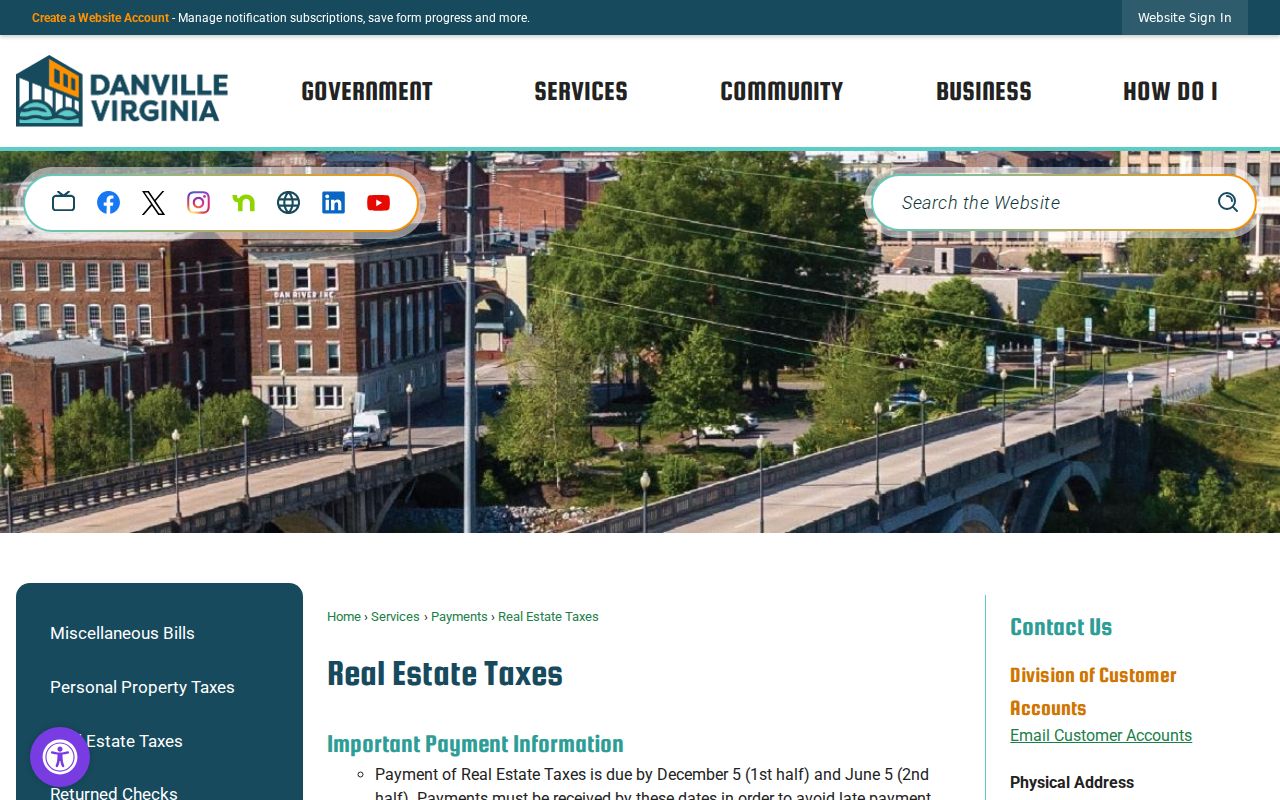
Danville accepts real-estate tax payments by mail, at the counter, through a drop box, online, and by phone. The City’s Paymentus channel adds a 2.75% convenience fee, which the City says it does not receive. A reader can choose a non-card route if that cost is not useful.
The delinquent list is updated monthly through the end of the prior month. It can include corrections, payments, penalties, interest, and nuisance-abatement invoice amounts beginning March 2014. Accounts referred to an outside collection agency may have charges beyond the list. Call Central Collections at 434-799-5125 for the amount needed to clear an account.
The City’s payment instructions describe the payment choices and fee. The delinquent tax page posts the monthly list.
The City payment page describes payment routes and the fee.
Use the list as a lead, then confirm a current payoff with the office.
Danville Tax Relief and Abatement
Danville runs an annual real-estate relief program for elderly or totally disabled residents. Eligibility rests on a few clear conditions. The City sets the bar at age 65 or permanent and total disability. Ownership must be held by June 30 before the tax year. The dwelling must also be solely occupied. Income and net-worth limits apply too. The general income limit is $40,000. It rises to $47,500 for a permanently and totally disabled applicant. Specified deductions are allowed. Thresholds shift from year to year. Confirm the figures for the application year you need.
Timing matters when you apply. The City page asks applicants to call during July, August, and September. Calls go through the Senior Citizen Center. Outside that window, Real Estate Assessment handles questions. City budget material also describes relief for veterans. These are veterans rated 100 percent permanently and totally disabled from a service-connected condition. No separate checklist is published for that route. Ask the City directly for the controlling forms.
Historic rehabilitation abatement works differently. Its application must be filed before, or alongside, any rehabilitation or building-permit work. The fee is $50 for a single-family home and $100 for multifamily, commercial, or industrial property. Counted work must finish within two years. Assessment then sets the base value and performs a final inspection. The City's relief page and abatement application spell out the full program terms.
Danville Roll Versus Recorded Deed
The assessment division keeps ownership and mailing records current for Danville. The City publishes no guaranteed refresh interval after a closing, though. July 1 anchors the tax year. A deed recorded after that date may not change the name on the tax-year bill. The land-record instrument may already show the transfer all the same.
So compare three dates: the deed date, the recording date, and the tax-year date. Check the assessment record for the roll presentation. Ask the tax office where a bill was sent. Read the deed itself to see who transferred and received the parcel. The person paying a tax bill is not always the latest grantee. They may lag the deed records.
Danville Tax Record Requests
Start with the online tax services when they answer the question. If a bill detail or older account record is not available, call the custodian or submit a Virginia FOIA request that names the parcel, address, record type, and date range. Central Collections is at Charles Harris Financial Service Center, 311 Memorial Drive. Real Estate Assessment is at 427 Patton Street, Room 301, and can be reached at 434-799-5120.
For a delinquent balance, use the parcel ID or account number and ask whether collection-agency charges apply. For a value appeal, request the current filing instructions from Assessment. The City appeal page outlines the grounds and the Board’s reassessment-year role, while the FOIA page lists request contacts.
The City’s appeal page shows the review route and current contact point.
Ask the office for the current filing year and deadline before sending evidence.
Choose the Right Danville Relief Route
Danville offers two distinct paths that homeowners often confuse. The elderly-or-disabled relief program is an annual application tied to the person. The historic rehabilitation abatement is tied to the property. It also depends on qualifying work that changes its assessed value. Neither one is a map overlay or a guess from an owner name. Read the current program terms. Call Assessment before you plan around either credit.
For the relief program, the City's criteria are specific. An applicant must be 65 or older, or permanently and totally disabled. Ownership had to be established by June 30 before the tax year. The dwelling must be the applicant's sole residence. Income and net-worth limits also apply. The general income limit is $40,000. It rises to $47,500 for a permanently and totally disabled applicant, with specified deductions. Those figures change with the budget year. Applications run through the Senior Citizen Center during July, August, and September. Outside that window, Real Estate Assessment handles questions.
Historic rehabilitation abatement works on a different clock. Its application must be filed before, or alongside, the rehabilitation or building-permit work itself. The published fee is $50 for a single-family home. It is $100 for multifamily, commercial, or industrial property. All counted work must be finished within two years. After that, Assessment sets the base value and performs a final inspection. A late request can miss the timing rule entirely, so confirm details before the first hammer swings.
Veterans rated 100 percent permanent and total for a service-connected disability may qualify for a separate route. The route is noted in City budget material. Ask the City for the controlling application and documentation list. A summary is no substitute for the real checklist.